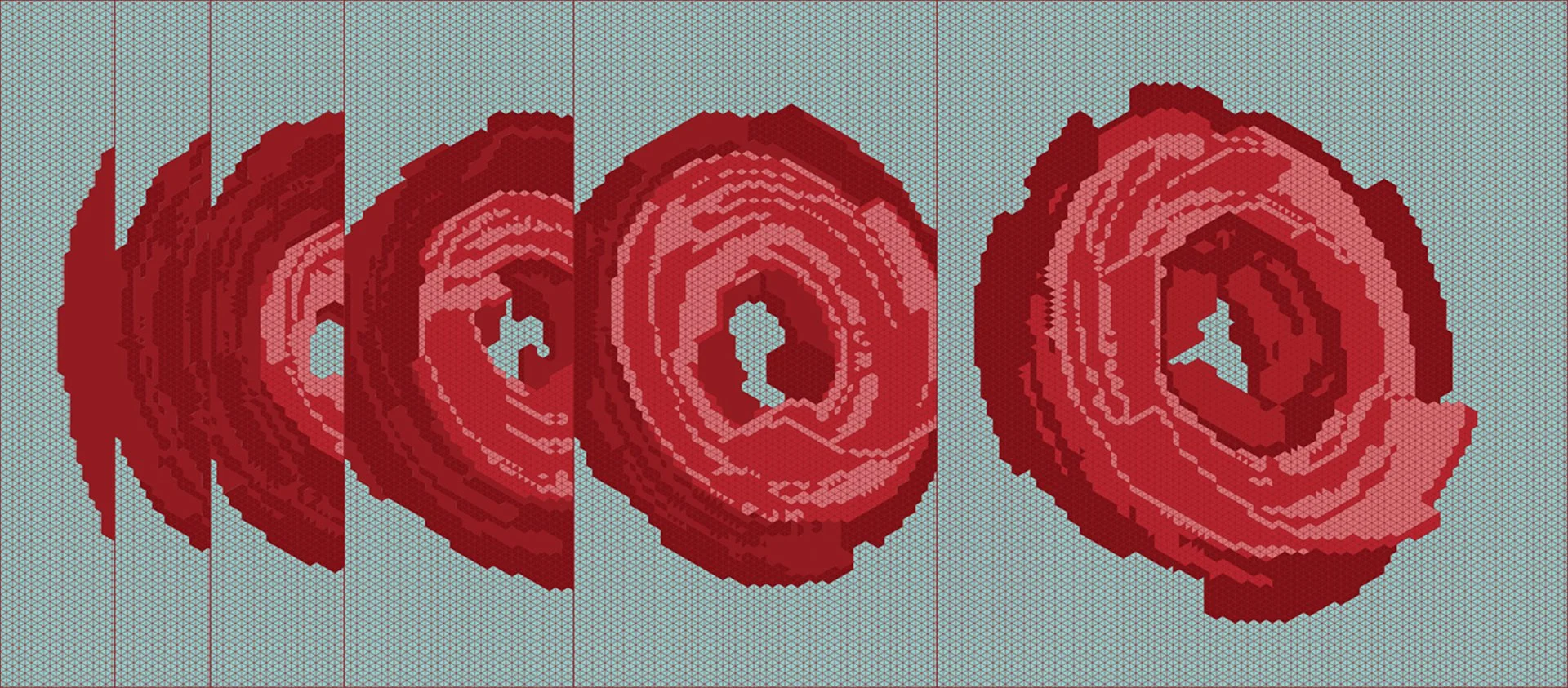
20 GOTO 10 REM SP*. 2025
20 GOTO 10 REM SP* is a series of five screen prints based on the sequential sculpture 20 GOTO 10. The works investigate technology and the representation of time and memory.
20 GOTO 10 REM SP#1.
Six colour screen print on paper (digital mock-up). 104 x 46 cm / 41 x 18 in. Edition of 20.
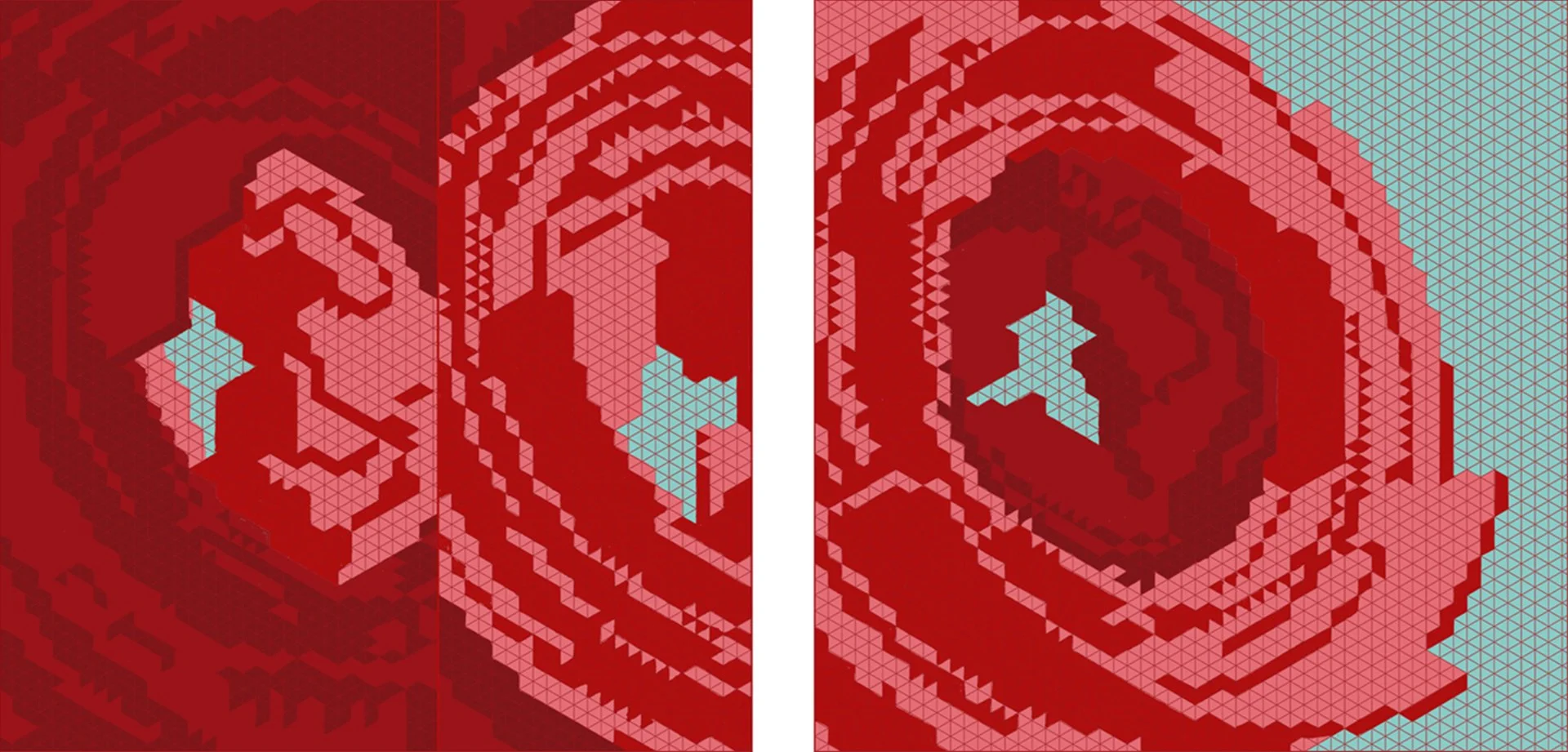

20 GOTO 10 REMP SP#2.
Six colour screen print on paper (digital mock-up). 48 x 23 cm / 18.75 x 9 in. Edition of 27.
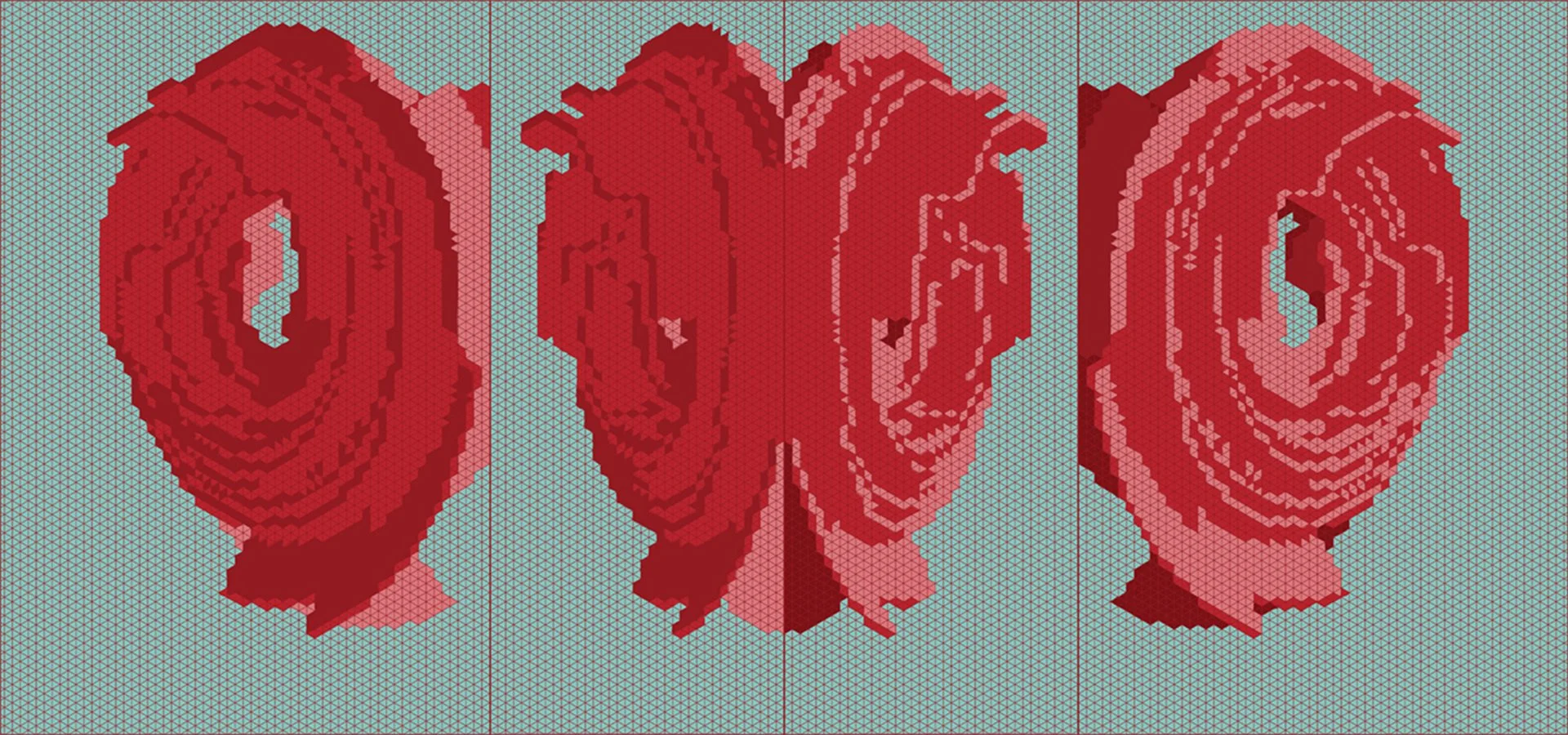
20 GOTO 10 REMP SP#3.
Six colour screen print on paper (digital mock-up). 38 x 38 cm / 15 x 15 in. Edition of 23.
20 GOTO 10 REM SP#4.
Six colour screen print on paper (digital mock-up). 81 x 38 cm / 32 x 15 in. Edition of 13.
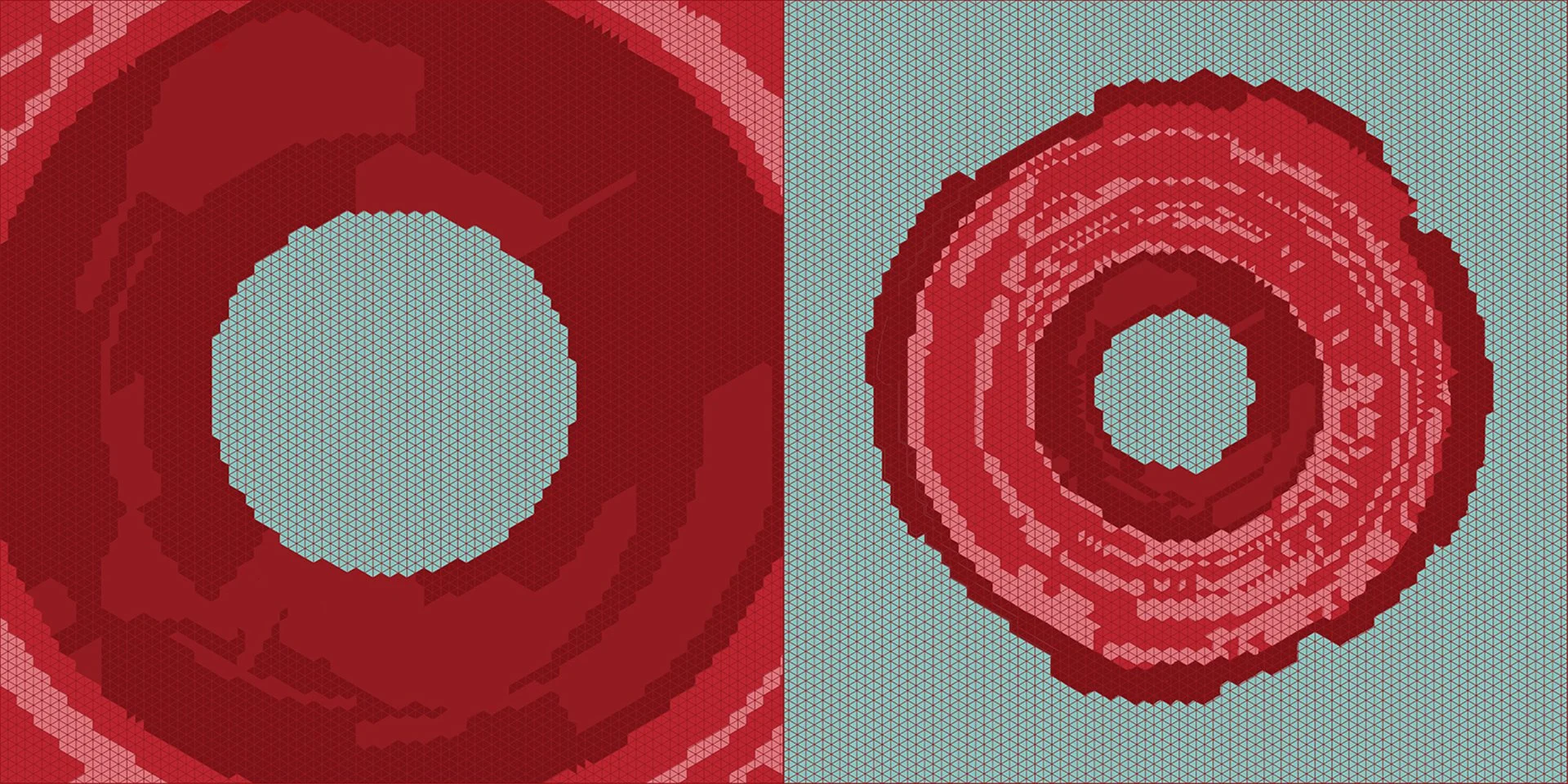
Time is linear, but memory is non-linear. We recall experiences out of order, merge events, and exaggerate details. We recontextualize the past using knowledge from the present. 20 GOTO 10 REM SP* explores this phenomenon by documenting the sequential sculpture 20 GOTO 10. Each of the five images presents a different memory of the work. Together, they form a non-linear storyboard that captures an experience of time.
When we talk about time, we typically refer to its measurement, such as days, hours, and minutes. These terms split time into discrete intervals, a process known as quantisation. The same technique is used when digitising sound and images. Everything we see and hear on digital media is quantised. While we perceive a seamless flow of content, we are actually experiencing discrete moments. The triangular grid of 20 GOTO 10 REM SP* references this quantisation. Viewed close up, the image appears pixellated and abstract. From a distance, the grid is no longer visible, and the eye resolves the abstractions.
20 GOTO 10 REM SP* is screen printed in five colors. Screen printing pushes ink through a mesh screen onto a surface. A stencil prevents ink from passing through. The stencils for this series were drawn by the artist and then recreated by a robotic arm using the same pen. This process focuses attention on the hand of the artist. One might expect the robot to produce a perfect facsimile, but variations in nib pressure, paper bleed, and device misalignment introduce idiosyncrasies. Contradicting the notion of quantisation, the machine has a calligraphy all of its own.
The title of this artwork is derived from the sequential sculpture 20 GOTO 10. It is a common line of code in 8-bit computer programming. “REM” is a command in the same language, an abbreviation of the word “remark.” It is the formal way of adding a comment. In written English, one would use parentheses (like this). SP* is a wildcard; it means SP followed by anything, in this case, the index 1 to 5. “SP” is an abbreviation of screen print.
20 GOTO 10 REM SP* was created in collaboration with master printmaker Laura Clarke at the Centre for Print Research, Bristol, UK. Robot tool paths were created by Nathan Churchill and James Knight.
20 GOTO 10 REM SP#5.
Six colour screen print on paper (digital mock-up). 76 x 38 cm / 30 x 15 in. Edition of 14.